I’m wondering if I’m missing something here. CAD$42 for tiles that don’t seem to be ‘optional’ because there’s no blanks included. Like the case design forces you to have some kind of tiles (self printed or purchased). That’s a rather odd case design decision when you look at desktop case purchases in general. What case passively forces you to purchase a front panel component? Shouldn’t there be having a non-plastic single-piece front panel option…(something that ought to be cheaper than CAD$42)?
I understand that nothing is free…and if the price isn’t listed out, then it’s baked into the pricing. It’s just odd that, [1] It’s CAD$42, for [2] Something that doesn’t seem to do a whole lot, and [3] It’s plastic.
I honestly don’t understand it either. I suspect it’s because Framework wanted to added their brand modularity to the product and they couldn’t find a better way than to split the front part of the case into relatively useless tiles that just add some design.
I’d recommend to either lean into it, and then you probably want to get different tiles than just the straight black ones, which are probably the most boring ones - or the other option is just to get a different case. Or maybe to 3D print you your own front panel. That’s probably still way cheaper.
Same for me, while it will mark the tiles as missing, it should be possible for you to go ahead anyway, without choosing any.
The front side will be looking a bit rough without though. If you can 3D print your own or want to create some laser cut or cnc front plate there is however no point in spending money on those. Also, if you simply don’t mind that tile free look you can just save these 43 CAD.
There are 3D filed on Framework’s github page to make it super easy to design something on your own or simply print the stock version yourself.
Just to clarify, the tiles are ‘optional’ from a web purchase form flow perspective. But what sane person would go with gaping holes at the front (i.e. not purchase the tiles. nor print the tiles themselves)? Meaning the design forces you to either purchase the tiles, or print your own tiles. Tiles are not really optional from a product perspective if you want it to look half decent as a desktop case. It doesn’t have an “I don’t care about tiles, just give me a traditional front panel / grill + dust filter” option.
To clarify it even further, you can really order the Desktop without tiles, but if you want a machine that doesn’t look unfinished you’d want some alternative front panel other than those tiles. I am currently not aware of third party offers so that means you’d need to DIY something. But if you want to do the latter anyway, at least you are not forced to pay for tiles which are in that case redundant anyway.
Yeah, but that’s introduces additional friction to the purchasing / near-ready-to-use experience. Plus, Framework is supposed to be environment-aware…what’s with the plastic tiles? Don’t create waste to begin with.
To be honest, I had a look at how the front looks without the tile frame. Actually, I don’t think it is half bad. The exposed small front panel board looks half finished but otherwise not that bad. Personally I think Framework should have offered a cheap single body option for people not interested in individualisation or tiles but I would not accuse Framework of wasteful design, just because their case uses a tiny bit of plastic to not expose the raw metal frame to the front. Do you mind the top plastic cover too?
If you’ve watched the Buy Now documentary (if you can call it that)…you’ll understand one of the takeaways is manufactures have a societal responsibility to not produce or minimize the production / reliant of plastic at the beginning of the lifecycle, starting from the design phase. Consumer consumption is a later phase…after products have been designed and manufactur with plastics.
It’s not waste if you’re going to use them. The customization feature is not for everyone but they do serve a purpose as protection for the front panel. Just like how the plastic bezels on the FW13/FW16 serves to protect the contact points and mechanisms but also have a customization feature. One could argue that the gaps in the tiles allows more airflow/heat dissipation compared to a solid panel. Plastic tiles makes them easier to pop off and clean, compared to if they were made of metal and plastic makes them arguably more resistant to denting or causing damage compared with aluminum.
Aluminum tiles or machining/casting an aluminum panel would also be more expensive than the $42 CAD you have to pay for the 21 plastic tiles and that would probably be baked into the cost of the original device. But Framework has given us the option to not purchase the tiles since people can 3D print their own which seems legit to me if you don’t want to pay the $42 CAD and have access to a 3D printer. So that does mean more complaints like this but at the same time, it gives us more autonomy about our computer purchasing decisions and more options to choose from.
I’m not entirely sure if it’s for anyone. This ‘way’ of customization seems like a solution to a problem that dosn’t exist. Like, have you heard “Geez, how I just wish there’s a case for me to print 21 tiles to the front panel”.
Grill.
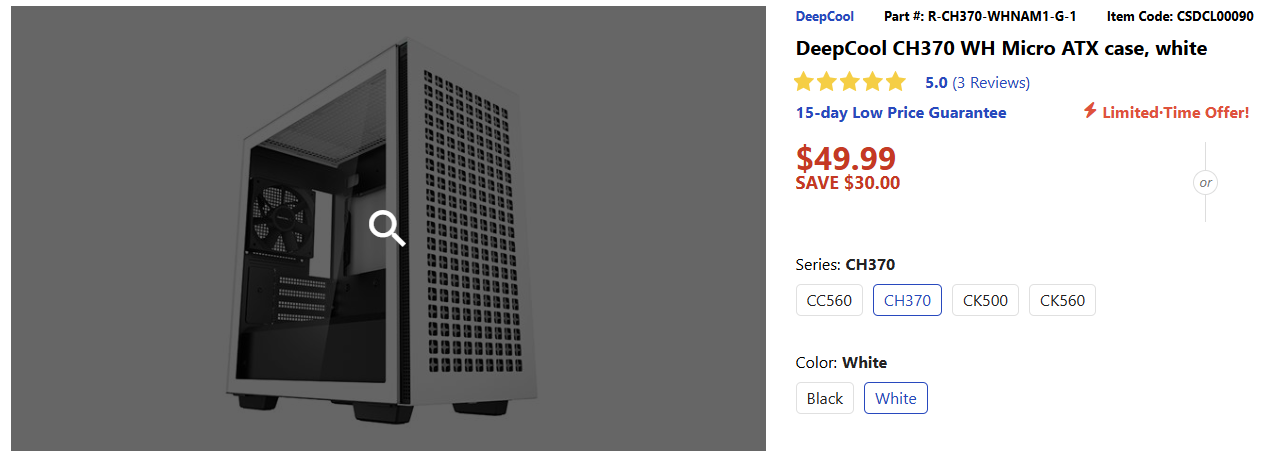
You can buy half 80% of an [micro] ATX case at that price.
I get it, customization is not for you. You do not represent 100% of the population, believe it or not. Get the motherboard and put it in a different case.
Machining a custom part to the same quality and standard that FW provides is very different than buying a cheap case.
The default is no tiles. It’s not forced on you. There’s no “problem” that’s needing to be “solved” here. You’re implying a non-existing problem that you’ve essentially created.
I would argue the default [expectation] is with tiles…see product sales page / marketing.
Alternatively, if we take your point that default is without tiles, the tiles are custom, and as such, custom parts are expensive.
No tiles would leave the case looking halfbaked.
Every action is to get from A to B, for a purpose. Every purpose ought to have a reason. Actions are to address a problem statement of sorts.
I still don’t get your point. Stamped and bent metal that forms the frame of the case is not presentable enough to serve the function of a case. You either need metal or plastic cover plates to serve that function. I can’t see how the tiles are more wasteful in that regard than a common efficiently designed case, with efficient use of plastic. The alternative, much more cost effective case option you posted, which may or may not feature a metal sheet on its exterior side. Indeed, more resources are probably spent on that case as it is considerably larger (it has an almost 10 times larger volume).
The carbon foot print of metal is hardly superior to plastic btw, especially for non-structural parts where the plastic does not have to be as strong as the corresponding metal part would be. On top of that, the plastic used for this case is not used for some single use throw away item but there to last a substantial time.’
PS: If you don’t like the stock case, just buy the mainboard and install it in whatever case with whatever PSU (that meets minimum requirements). Yes it was already deliberately designed that way in that mini-ITX form factor that this is an option, so it is false to say this was not considered already during the design phase.
The mainboard is a standard mini itx board, it should fit into almost all regular cases. Most will just be bigger than necessary, but that gives you additional room for fans/cooling/noise insulation and a PCIe card, which is not a bad thing.