With the size, specs, and TDP of the Desktop it could be a solid home server. Support for SR-IOV with its iGPU would be next level. Especially since there isn’t really an option for SR-IOV for consumers that doesn’t require a crazy amount of money or using ancient enterprise cards.
1 Like
If I’m not mistaken, this requires the APU to have support for the feature, not just the BIOS. I couldn’t find any mention in the AI 300 series specs of SR-IOV. This doesn’t mean that it isn’t supported; AMD just doesn’t mention it anywhere. That being said, they actually don’t list any of the Virtualization capabilities of the AI 300 series. I even checked several 3rd party spec sites like techpowerup.com and there is no mention of SR-IOV support.
Framework may have to ask AMD directly if this is supported at all. It may be beyond their control in the end. That may also explain why we don’t see more consumer options for home servers with SR-IOV; it may simply be a feature they leave out of most consumer-grade chips.
1 Like
tl;dr: don’t hold your breath.
An AMD GPU is the most distant choice for anyone thinking about SR-IOV.
Their consumer GPUs are well-known in the home-labber/virtualization enthusiast space to not support SR-IOV. Some are a nightmare for just PCIe pass-through.
You’d be hard-pressed to find even documentation that their professional GPUs support SR-IOV―even the ones that actually do.
1 Like
Not sure if anyone has any updated info on this? It would be a huge help if Strix Halo supported this, methinks.
I read a few technical papers back in college, virtualizing “integrated” graphics is WAYYYY easier than virtualizing a dedicated device. This would be amazing, I also haven’t seen anything about it. But would love someone like Framework or Wendel from Level1Techs to poke AMD about it.
1 Like
Who from Framework would be the best to ask? Also, do you know whether Wendel from Level1Tech is on these forums?
So I can say the HX370 in general does support it, so there’s no reason the 395 shouldn’t.
its in the same section that Rebar and above 4g decoding sits (PCI Subsystem Settings)
At framework? no idea, not sure how to contact them aside from public emails/support?
You’d probably need to poke Wendel via the Level1Techs forums or twitter?
Where did you find information that the iGPU in the HX370 supports SR-IOV? I can’t find anything with a quick google search but that’s amazing to hear
i have 2x hx370 devices already and its there in the bios in the section i mentioned
1 Like
I didn’t see anything in the Framework Desktop bios, but I could have missed it.
This is really cool to hear. Which HX370 devices do you have?
I’ve seen a review of another AI Max+ 395 unit (either GMKTek or Beelink one) on YouTube and when they entered BIOS, there was an option for SR-IOV there. No idea if it actually works, but the option was there (disabled by default).
EDIT: Found it! Here: https://youtu.be/awYSXr0SrIs?si=6YRA6AVK5Td-Yl6S&t=216
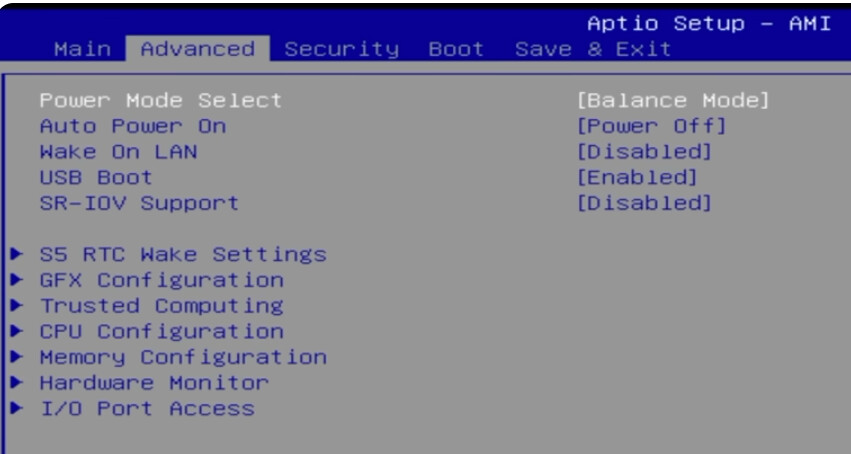
2 Likes
That is awesome!! Hopefully it will be available in the Framework Desktop BIOS!
bit different then you would expect, but onexplayer f1 pro and the x1 pro but its just the standard amd bios in them
if its not youll most likely be able to enable it using something like smokeless universal form browser.
and sr-iov does work when enabled
 that framework adds the support because I’d love to run GPU accelerated VMs on this… that would really make this my holy grail of a platform
So, what are some channels we can send this request for SR-IOV support?
BIOS support is just one component, but Linux kernel needs to support it too. I don’t know if AMD supports SR-IOV on consumer hardware at this point.
There are three SR-IOV problems we are talking about here.
This is supported on consumer hardware with the meaning of “supported” being that it supports hardware that supports SR-IOV. It’s a setting found on ordinary consumer motherboard BIOSes.
For the entire SR-IOV set-up to work, you need three of the most important things:
- The PCIe device itself must have SR-IOV capability. (This depends on your PCIe hardware/firmware.)
- The system firmware (BIOS or UEFI) must support and have SR-IOV enabled. (This is the stuff you find in BIOS.)
- The CPU must support and have enabled an IOMMU (Intel VT-d for Intel, AMD-Vi for AMD) to safely isolate and assign PCIe resources to different virtual machines or environments.
The main problem is the integrated GPU really. Intel’s integrated GPUs have had it for a while. AMD’s integrated GPUs have not. NVIDIA has theirs locked behind a subscription.
With the Intel-NVIDIA partnership, this could get interesting. 2027~2028 is the earliest which their partnership would produce real products, and I’m wondering if Intel will make NVIDIA make their integrated GPUs SR-IOV-friendly.
1 Like