couldn’t you drill a hole next to the usb c port and have a connection like an audio jack or something similar so that it is automatically plugged in when you put in the card?
This would mean that the expansion card has another connector next to the usb-c sticking out.
Don’t know if that makes sense, but I just thought of that.
I considered that. Probably would be hard. On the inside there is motherboard on both sides of the USB-C so you cannot fit much there. And you cannot put much on the outside, as this would preclude inserting other expansion cards. Also, it would need to be a specialized RF connector, it definitely wouldn’t work over an audio jack. Probably an IPEX because there is not much else in way of small-footprint RF connectors. Maybe you could fit an IPEX extension cable and presicely position it between the motherboard and the expansion card shell. But seems very hard from a mechanical design and required precision standpoint.
2 Likes
Hi yall, it’s been a while. I made a shell design for the card from the official 3D printable expansion card shell CAD, and test drived it for some months (on a non-framework laptop, since framework does not sell to my region). Happy to report that the electronics is reliable enough for my use. On average I get ~20 Mbps down and ~7 up on 2 wimpy FPC antenna, which is still good enough for remote desktop access and youtube playback.
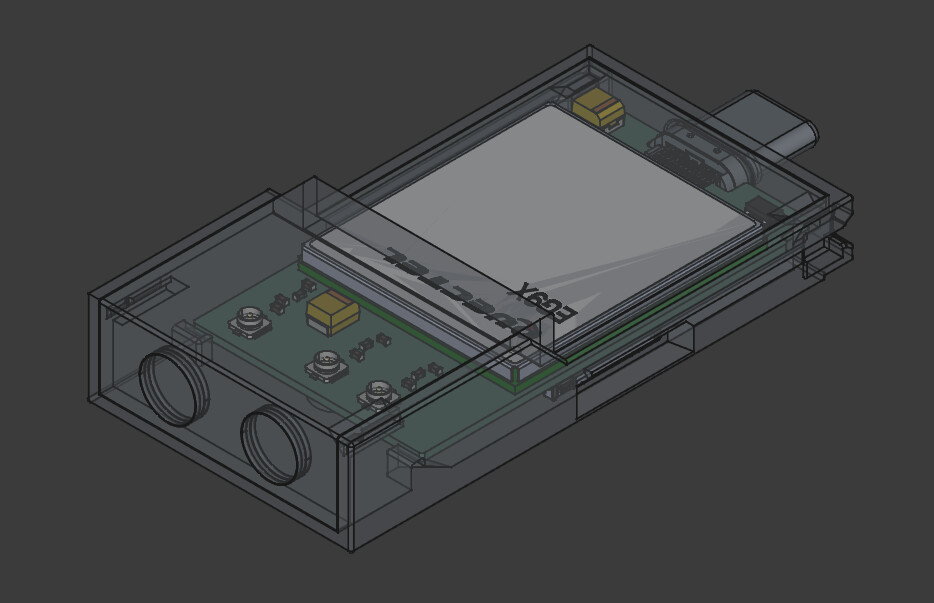
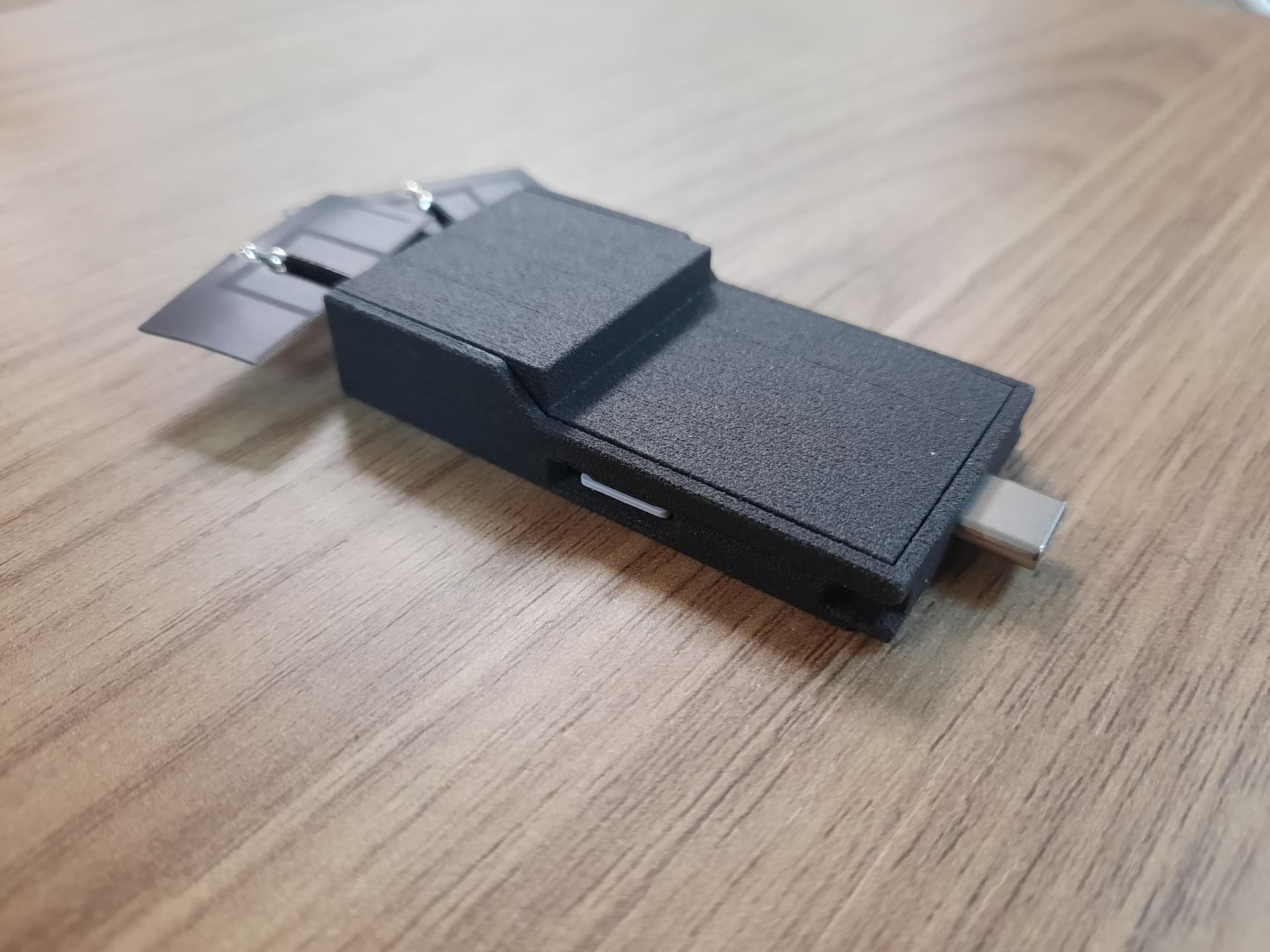
This was printed with JLC3DP’s 3201 PA-F nylon SLS. I’m not a mechanical engineer though, and the shell must have a lot of things that should have been designed better. As I don’t have a framework laptop, I also could not test fit it in an expansion slot. Anyway, I have published the 3D shell design in the git repo, feel free to do whatever.
12 Likes
Hi guys! Any progress on this front?
Would be cool with 2 different versions of the chassi. One with a small pcb antenna, and one with support for SMA for areas with lower coverage.
The git page still shows the board as untested, but seems like a lot of you guys have gotten em working correctly?
I have been using mine every day for several months and seems fine. Reception is weaker with current antenna setup. Works well in the city, less in remote locations. Reception is better with an antenna that is separated from the laptop chassis.
I think SMA is still too impractical. However, I think one could 3D print a chassis with small hinged antennas that fold to be flush with the laptop side when not in use. But will have to think more about the design.
Also, @FelixL still has my other prototype unit, promised to work on the case but stopped responding.
1 Like
Good to hear, what repo of 4g modem are you using? Saw that there are 2 different. I know SMA might seem impractical but if I could hotswap between one with builtin and with a larger antenna I would be very happy and not really thing about it hehe.
Hey,
Any plans to sell them? In the USA. and would love to buy one.
In IT but don’t think I’d be able to build one.
You don’t need to build one per se. You just upload some files to JLCPCB, check a few checkboxes and have it manufactured. The only problem is that the smaller the quantity, the more expensive it gets, so it’s probably best to coordinate with other people in your region.
Also, as discussed throughout this thread, so far nobody has come with a particularly satisfactory antenna solution. I’m now studying up on antenna theory but it seems rather arcane.
1 Like
I am using my own design, that is, regnarg/framework-eg95: 4G LTE expansion card for the Framework Laptop based on Quectel EG95 - Codeberg.org
because of them sticking out, or because of them not working satisfactorily?
I have experimented only with FPC antennas in various positions, but they seem to perform poorly whenever close to the chassis, even if sticking out a bit. Not sure what the status of the SMA version, there have not been many updates in this thread.
I mean there would be a little space below the adjacent expansion cards, but i doubt you could get antennas in the right shape
I have some ideas stirring around:
- A custom built compact hinged antenna, basically like the SMA concept but much smaller. Should be possible with a 3D printed body and an off the shelf thin and long PCB antenna. When folded should lie along the laptop body, making it only slightly wider.
- A SMD chip antenna on the PCB, sticking 5-10mm out, working in conjucntion with the chassis as counterpoise. Would be probably a bit hard to get right, require measurement and tuning and multiple iterations of the expensive PCB. My budget is limited.
- A bit wild: make a double expansion card (taking up two slots, with a common protrusion over the width of the two slots). One of the C ports would be passed through out, as if there were a standard Type-C card, other would be used for the modem. This wider protrusion could hide a longer antenna (which is essential for LTE 800 MHz - for a λ/4 antenna you need 94 mm) and put it a bit farther from the chassis. Maybe there would then be even space for a GNSS antenna? Cons: would be hard to insert and remove. Less flexible. Possibly not compatible with FW16 without case change.
- A variation on 3: instead of covering two slots, the protrusion from the card could stick out to the side, forming kind of a thin L shape over the area where there are no expansion slots (would probably have to be in front right slot, on the left it would clash with headphone jack). Would also allow hiding a long enough antenna. Would be kind of non intrusive because it would just make the laptop body slightly wider. Cons: possibly fragile and could break of (large leverage on thin piece of plastic).
Other suggestions welcome.
First step would probably be to get a NanoVNA and start measuring various antennas in various positions in relation to the chassis.
3 Likes
why could option 3 be non compatible with the FW 16?
Possibly there may be different spacing between the adjacent slots. Did not check this.
3 and 4 should be definitely easiest to both implement (require just printing a larger case for the existing pcb) and test (even without the case I can just temporarily fix the antena besides the laptop with a few mm distance).
Overkill option combining 1+3/4… main antenna hinged, diversity antenna in protrusion. On good signal, could work without hinging. On bad, you could hinge to get two decent antennas with some distance and perpendicular to each other, which could also help with catching signal from different directions.
1 Like
Yeah, RF engineering isn’t considered black magic for nothing. From the bits I’ve looked at over the years, it takes a higher level of knowledge, expensive equipment, and skill to do well or even adequately, too often.
2 Likes
Claude thinks that a λ/4 wire monopole perpendicular to ground plane (i.e., 94mm hinged antenna deployed to vertical position) will give the best results achievable in amateur conditions. Should be also easiest to test and tune (clip the wire bit by bit until you get the right frequency on the NanoVNA). I’ll try to experiment with that when I get the necessary equipment.
Cons: will be tuned for mostly 800MHz (B20).
OTOH, 800MHz is the only thing you need in exurban weak-signal settings. Higher frequencies like 2100 or 2600 are used in dense urban areas, but then you usually have absurdly good signal (few hundred meters to cell tower).
The weakest case for this solution will probably be inside buildings in urban areas, especially with thick walls. But there one can often fall back to wifi.
We can also use a wide-band FPC for the diversity antenna to improve things a bit.
I wish you could partner with Framework for this and actually sell this, since you are putting so much effort into this and its an awesome idear
Based on this thread, this seems to be of interest to maybe 100 people. Sound as a rather hard sell….
I’m putting in effort because I need it for myself. Sharing it is just a side effect. As I said, I am already daily driving it and while performance is far from optimal, it is still very useful and far better than nothing.
1 Like
Yes, the spacing is different between 13 and 16.
2 Likes