@tbe Hi, I have questions about your project, and would like to talk to you personally. Please reply back here with how I can do that.
I’m new to Framework forums.
I have experience in PCB and electronics design and already started modifying your design to be more suitable for mass production. I do have some questions on the decisions you have made and would like to credit you if it goes well.
Everyone: It would likely need some form of prepayment to continue. Something like crowdsourcing. What do you guys recommend?
David, you might encounter antipathy or negativity to suggestions about crowd funding this particular hardware project. Many forum members, myself included, invested in a similar project which did not bear fruit.
I am open to another modestly-priced investment. I wish your project success and will indubitably find a dual USB port, with or without PD support, to be an enhancement to my FW13.
If you adopt a pre-payment model, how much will you need to charge to recover your production and distribution costs for a small run?
That’s a reasonable expectation. We bought a windshield wiper from a Kickstarter and while they did deliver, it fell quite short of expectations. And another was a ultrasonic toothcleaner that was supposed to clean it in 30 seconds, but it was next to useless and that was for already existing stuff. But there was a leather belt that was really good which we still use to this day.
So if there was a way to fund with minimal to no losses to both me and the potential customers, let’s do it. I can tell you that once it starts I will deliver it, but talk is cheap.
I will need to look at the BoM in detail but usually the production cost itself needs to be at most 1/2 of the final cost(this excludes shipping), ideally 1/3rd. My first product that went on Amazon was funded entirely by me and the sales were below even my low expectations, so now I know that’s a bad idea as well.
Perhaps one way of meeting halfway is finding out there’s actually enough people to mass produce(50+ people) and send small samples to few(4-6) people to prove that at least I can promise to do this and build trust. Though that’s why I ask if there are alternatives methods/ideas to this.
You can do a “group buy” (what you seem to be describing) without Kickstarter. You can preserve buyer protections if you use a normal payment platform.
How it would go:
You pay for the prototype out of your own pocket.
Demo it online on various platforms.
Start a group buy (i.e. take payment info, but don’t charge until enough customers pledge).
If enough customers pledge before the deadline, capture payments and put in the manufacturing order.
You could take payment via PayPal (edit: Stripe seems better for taking payment info ahead of time) and track group buy status with something like Trello. There’s a lot of options.
I am also one of the many. This particular community will be especially wary due to bad experiences.
I’m going to do all to avoid moving physical connections. I don’t want to deal with that. That will be true of the 3D design part. @tbe already seem to have got it working fine. I will keep you guys updated. And thanks for the suggestions @Jacob_Padgett
So looking at the design, delivering max 1.5A to both ports might be a bit of an issue as the upstream port(from the laptop) can deliver 3A, while it has to be split between two ports. That’s not the issue. If it’s consistent it’ll be ok, but if both ports happen to exceed 1.6A for more than a brief period, then it’ll trigger a current limit to the upstream port. 1.6A is too close to my liking but I have to work with what’s available. It might also be ok.
Also, I will be asking for 3 testers. I will give out the prototypes to people with unique usage scenarios. Maybe one just uses it for low power like mouse. The other for mainly display. Things like that.
Looking at the design again, it seems that conclusion was a bit premature. Either tbe hasn’t put the latest design online or he hasn’t finished it. The 1.5A for both ports should not be a worry.
@David_Choi I’m not sure if you’re able to ship your prototype to the US, but I have multiple use-cases I can think of for a dual-USB-C expansion module, such as a low-power USB-C smart-card reader + power delivery to a phone, or displaying to an external USB-C monitor and powering a phone. Feel free to DM me and we can share details.
Oof, this is a bit of a mistake on my part. This can transfer data but it doesn’t do display out. I don’t know where I got the idea for Displayport ALT. I might have been reading up on too many datasheets.
I’d be up for 1-2 of those extension cards if you manage to make it happen.
Happy to test as well, but I’m in France, so probably not the most convenient for shipping.
My use case is super basic: I have 2 USB-C ports taken for charger and external display. One usb-A is the mouse, so I’m just left with 1 extra port, which ends up rotating depending on needs (which include a usb-c nitrokey that has to come in/out each time I need it. Not a disaster, but clunky).
Obviously being able to plug charger + USB-C display on the same card would be ideal, but at this point, any combo would be an improvement!
So a displayport ALT is not possible. I looked it up and it only comes with PD spec, which is 20V, which won’t be this version. Something that works on older USB-A standard should though. So it would be for storage, low power USB(up to 5V, 1.5A/7.5W per port), and charging.
Posting updates about the project here is good for everyone right? Reddit is much bigger, but it just gets buried so quickly, unless there are tons of responses, or I can get it stickied somehow. I thought of Discord too, but I’m not sure if I want to manage. It’s already a 1-man project for this one.
I’m not going to promise anything fancy, other than the one I’m working on is for basic functionality. After this sure, it can be different. And for selling I want it compliant with the basic USB-C specs.
Hi everyone,
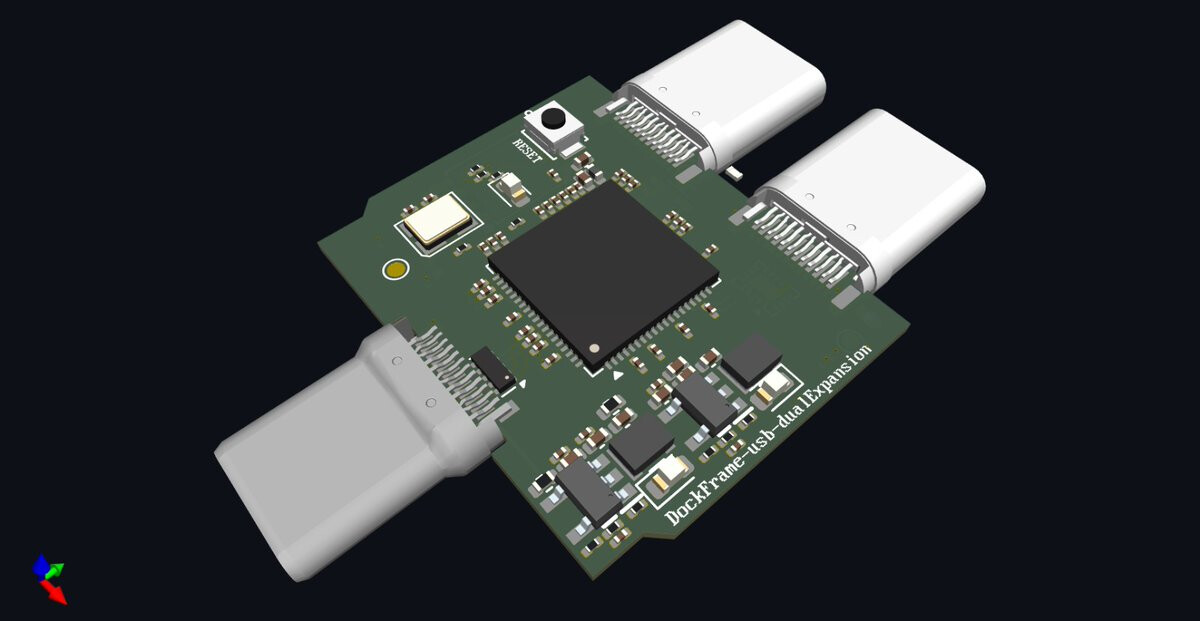
I recently found this thread and realized I’ve been independently working on a dual USB-C expansion card focused on USB 3.x data (hub-based, no Alt-Mode, no USB4, no PD).
I’m part of the DockFrame project (dockframe.com), where I’ve been designing modular USB-C hardware, and this expansion card comes from that experience.
The current focus is signal integrity and the mechanical constraints of the Framework expansion bay.
I’m validating routing and layout at the moment.
Any technical feedback or suggestions from the community are very welcome.
Hi David, thanks a lot for your feedback, I really appreciate you taking the time to point that out.
The height difference comes mainly from the fact that the upstream port is a male connector, since it plugs directly into the laptop, while the two downstream ports are female connectors intended for external devices. Because of their different mechanical constructions, their profiles are not identical, which results in that height variation.
That said, I’m paying close attention to the mechanical fit within the Framework expansion bay to make sure everything stays within spec and works reliably.
Thanks again for the input, any other observations are very welcome.

 .
.