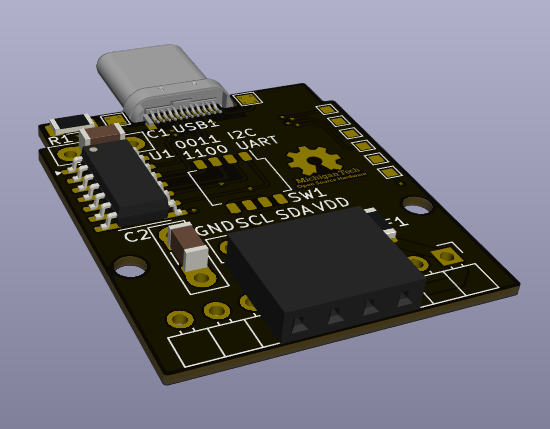
As our semester wraps up, we have an update for our I2C expansion card! For those of you who missed our introduction post, we’re a team of students at Michigan Technological University working in the Open Source Hardware Enterprise (OSHE). We are currently developing both an I2C expansion card and a front display for the desktop (learn more about that here).
Our goal for the I2C expansion card this semester was to create a fully functioning card that fits within the specifications of the Framework expansion card system. Throughout the design process, we ran into a few challenges — one of the main ones being whether to include both male and female pin headers on the same board. Doing so would have required the card to extend outside of the laptop’s form factor, which we wanted to avoid.
In the end, we decided to create two separate PCB designs: one featuring female headers and one featuring male headers. This approach keeps both versions compact and fully compatible with the Framework’s expansion bay system.
If you’d like to learn more or follow our progress, you can find our GitHub here. As always, OSHE is committed to keeping all of our projects open source and accessible for everyone.
We’d love to hear your feedback and suggestions for future iterations — community input helps us make these designs even better!
We have a slightly revised design in the works for the card, and during that assembly process, we’ll be working on better assembly documentation on our github. Once we get the boards in and validate them, we’ll package it all into a new release for you guys. It will have protections against plugging in >5V into Vo on the connector, but otherwise is electrically identical to the old design. We will also be validating UART on the card, since we now have the switch to make that possible.
The I2C Card has passed our internal testing, and we’re just working on improving the assembly instructions on the wiki now. That will be completed in the coming weeks.
Somewhat large update here as we wrap things up on our end. I2C/UART card is feature-complete, and we’ll be handing this off to the community going forward if there are improvements or modifications that need to be made. We are thankful to the community for providing us with ideas, and suggestions for improvements to each project.
Special thanks go to framework themselves for sending us one of the Framework 13 motherboards, and Cooler Master case, which have been used to validate our cards for use with other Framework devices. When we’re not using it, it works well as a computer for general lab usage as well, and we haven’t had any big problems with it, just a few setup quirks we nailed down pretty quickly. If you’re looking for some things to add to your Framework, feel free to take a look at our Magnetic Charger and Mouse Dongle cards. They’re what we’ve been spending most of our time on outside of the desktop display, and we are quite happy with how they turned out.